
Taupō Timebank
From a Dumping Ground to a Garden: The Story of Taupō Timebank Community Gardens...
From a Dumping Ground to a Garden: The Story of Taupō Timebank Community Gardens
There’s a spot on the edge of town that used to be nothing but blackberries and other people’s rubbish. Now it’s garden beds, a stage, a bar built from salvaged bricks, and soon, a coffee cart with a pizza oven parked beside it. The man behind it, Blair, didn’t set out with a masterplan. He just kept saying yes to the next thing.
Where it started
Blair’s first brush with time banking wasn’t in Taupō at all, it was about 15 years ago, over in Raglan, through a friend. Time banks were popping up all over the country back then, and something about the idea stuck with him: a way for people to trade directly with each other, hour for hour, without money getting in the way.
“It’s a way that people can trade directly with each other without being ripped off essentially, but it’s also a way to connect community, connect people face to face,” he says.
The idea sat in the back of his mind for years. Then COVID hit. “It was a big sort of shot across the bow,” Blair says. “Watching people isolated and disconnected was the wake-up call. It felt like the right time to bring a time bank to Taupō.”
Garage workshops and a fruit shop
It started small, a bunch of mates learning self-sufficiency skills in Blair’s garage. Sauerkraut and kimchi. Seed swaps. How to make your own alcohol. At the same time, Blair was running Lake Local, a fruit and veg shop in town, delivering veggies through lockdown.
Then came the land.
From blackberries to garden beds
The block Timebank Community Gardens now sits on used to be a bit of a dumping ground, blackberries, rubbish, nothing much else. The turning point came almost by accident: a group of cadets arrived one day to clear scrub from behind Blair’s shop.
“There’s about 10 or 12 of these kids, and it took them about two hours, and they just smashed out this massive thing,” Blair remembers. “I thought, that’s quite incredible to watch a group of people, just like a bunch of ants… do a lot in a short amount of time, coordinated.“
That was the spark. If a small, coordinated group could clear that much ground that fast, why not clear a bit more and grow something in it?
A proposal went to council. The original plan had the gardens by the road to Spa Park but the right conversation with the right people saw it moved to its current spot instead. From there, momentum built fast: local companies Chemex and Downer brought in a bulldozer to clear the site, and Mitre 10 donated all the timber for the garden beds. “We had this massive piece of land and a whole lot of timber,” Blair says. Volunteers came and went, as volunteers do, so a lot of the actual building came down to Blair and a handful of loyal mates, doing it themselves, board by board.
Even the bar has a story.
It started with a stack of dumped bricks out the back that Blair and his mates decided to put to use. The first version wasn’t exactly up to code so it came down and got rebuilt properly.
A place for kids who don’t quite fit the mould
Once the space existed, Blair and his mum Lyn, a former primary school teacher, turned their attention to who it was actually for. Families, and kids especially, felt like the obvious answer.
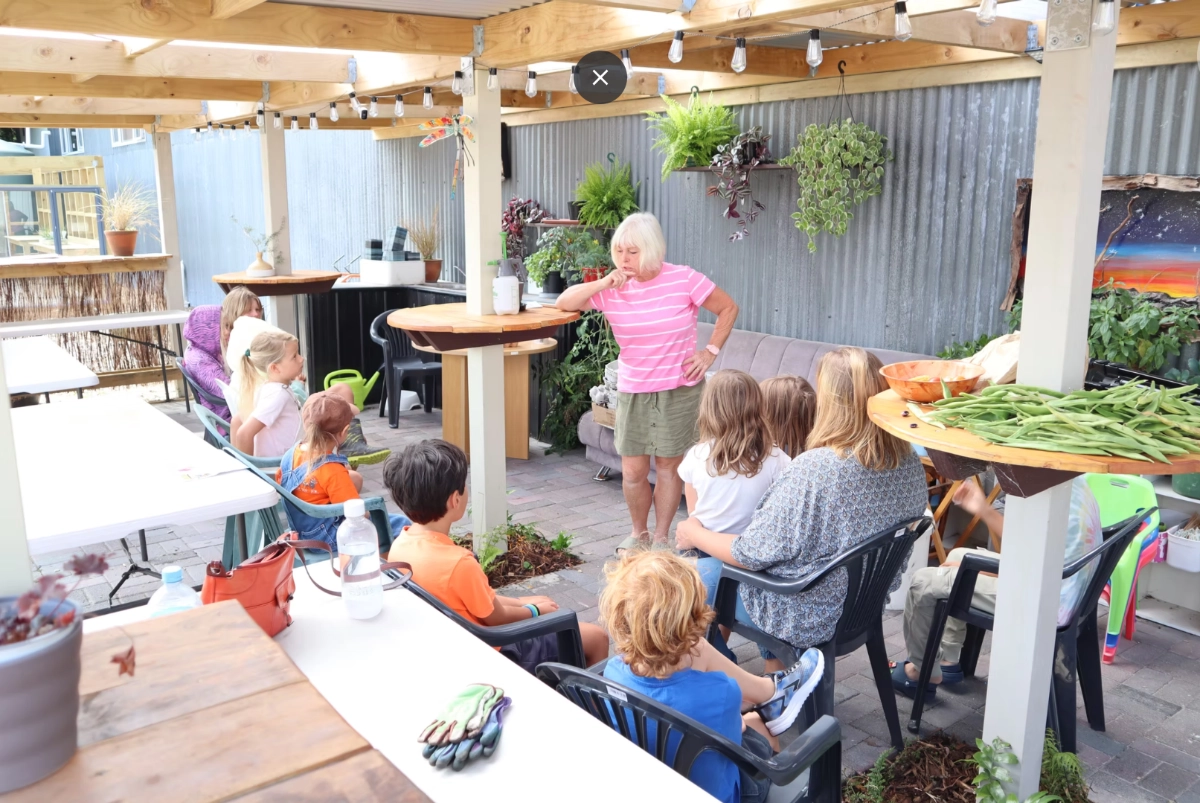
Now the gardens run a genuine mixed bag of programmes through the week: Education outside the Classroom, Intermediate kids, younger homeschoolers, an older kids’ Pathways group, and Blair’s favourite cohort, kids referred through Alternative Education, who aren’t currently in mainstream school.
“To me, they’re perfect students because they’re malleable,” Blair says. “They just need time.” He sees the garden as a chance for kids who’ve been ground down by the classroom system to do something with their hands instead, build things, learn composting, plant thousands of seedlings, and feel like they’re good at something again. It’s not always smooth sailing (there’s the occasional bamboo sword fight to break up), but Blair reckons most kids who come through just need space to be themselves rather than be managed.
Tama, and what the place is really for
One story sits at the heart of why Blair keeps going. Through a family connection, the gardens raised money for a young boy named Tama, and he’s now able to walk.
“That’s exactly what the place is for,” Blair says simply. It’s the clearest example yet of what he hopes the gardens will keep doing: quietly showing up for people in the community who need it.
Growing beyond the fence line
What started as a time bank has become something much bigger, concerts, a stage, and events like Blues, Brews and Barbecues, which pulled in around 400 people last summer. A group from Tokoroa even used the Taupō gardens as inspiration to build their own garden beds at a local school.
“These places need to be everywhere,” Blair says. He sees real potential in local reserves and community spaces being repurposed the same way, with a bit of public appetite for change, he thinks more towns could run something similar.
What keeps it going
None of this has been easy, or particularly profitable. Blair describes it candidly as “hard financially” but he kept his word.
“I had to follow through with a promise. I just knew that it would work. I believed it would.”
People have sponsored individual garden beds along the way, which funded the early days and eventually opened the door to grants. Blair puts a lot of that support down to the story behind the place being an easy one to believe in grassroots, community-first, and never about any one person getting ahead.
What’s next
Summer’s shaping up to be busy. A coffee cart is in the works, an ice cream machine, toasted sandwiches, a pizza oven, pending council food registration, which Blair expects will take a couple of months to sort. There’s talk of the Blues Club packing out the space again, and more live music planned for the warmer months.
I asked Blair what he’d build with unlimited money and he pushed back on the question itself.
“It would almost defeat the purpose if we had the money to do it that way,” he says. “It needs to be something that’s able to be done without a whole lot of money. That’s the whole point.“
How to get involved
A lot is happening behind the scenes to keep Taupō Timebank ticking along. It’s opened up to schools through the Pioneer programme, there are volunteer days and fix-it workshops on selected Saturdays, and the long-term goal is to be consistently open on set days each week.
Right now, the best way in is to:
- Follow along on Facebook to keep an eye out for upcoming events and workshops
- Show up and support the events and workshops as they’re announced
- Give them a call to ask what programmes are currently open for enrolment
Taupō Timebank Community Gardens is one of Taupō Local’s founding features. If you’d like to get involved, volunteer, or find out more about the gardens programmes.
Mobile: +64 21 030 4464
Email: info@taupotimebank.org
Website: www.taupotimebank.org



Be the first to comment